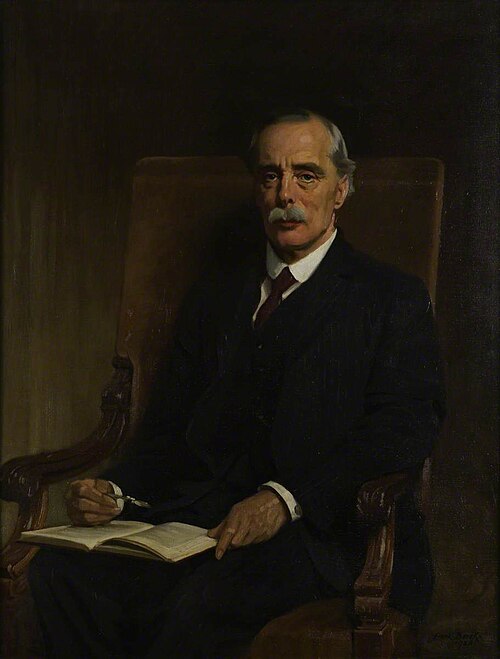
 Alfred William Pollard (August 14, 1859 – March 8, 1944) was born on August 14, 1859, in London, England.
Queer Places:
40 Murray Rd, Wimbledon, London, SW19 4PE
King's College School, Southside, Wimbledon Common, London SW19 4TT, United Kingdom
University of Oxford, Oxford, Oxfordshire OX1 3PA
St Mary's Churchyard, Wimbledon, 30 St Mary's Rd, London SW19 7BP, United Kingdom
Alfred William Pollard (August 14, 1859 – March 8, 1944) was born on August 14, 1859, in London, England.
He pursued his education at King's College School and subsequently at St John's College, Oxford, where he matriculated as a scholar in 1877. During his undergraduate years, Pollard formed significant intellectual and personal bonds with contemporaries who would leave lasting marks on English literature and scholarship. Notably, he shared a staircase with the future poet A.E. Housman, with whom he shared classicist pursuits, while the third member of their close circle was the science scholar and athlete Moses John Jackson. In their final undergraduate year, Pollard, Housman, and Jackson shared accommodation outside the college.
Following his graduation, Pollard embarked on a distinguished professional career, dedicating decades to the British Museum, where he worked in the Department of Printed Books from 1883 until his retirement in 1924, eventually serving as Keeper of Printed Books. Beyond his institutional curation, Pollard revolutionized the field of textual bibliography. Through meticulous analytical bibliography and examination of printing house practices, he fundamentally transformed the study of Elizabethan drama. His seminal works, including Shakespeare Folios and Quartos (1909) and Shakespeare's Fight with the Pirates (1917), successfully exposed the corrupt nature of many early texts and vindicated the authority of the "Good Quartos," establishing a rigorous new standard for editing Shakespearean literature.
Pollard's biography intersects significantly with LGBTQ+ history and literature primarily through his lifelong friendship with A. E. Housman, whose personal life was defined by his unrequited and deep romantic love for Moses John Jackson. While Pollard was a conventional family man—marrying Alice Emerson in 1887 and later suffering the tragic loss of two sons in World War I—he remained a vital keeper of memory regarding Housman's inner life. Decades after their university days, following Housman's death in 1936, Pollard provided crucial testimony to Housman's first biographer, A. S. F. Gow, offering intimate glimpses into the domestic dynamics of their youth. Pollard recalled how Housman and Jackson spent their evenings together while Pollard worked independently, and he pinpointed this intense infatuation and distraction as a contributing factor to Housman's devastating failure in his academic finals. Despite the profound emotional turbulence that defined Housman's secret romantic orientation, the bond between Pollard, Housman, and Jackson endured across decades, highlighted by middle-aged reunions hosted by Pollard at his home in Wimbledon. Pollard spent his later years continuing his bibliographical pursuits, serving as president of the Bibliographical Society, and passing away on March 8, 1944, leaving a legacy as both a titan of literary scholarship and an essential witness to one of the most famous unrequited queer attachments in English literary history.
References:
Support this project
This website is a passion project researched, developed, and funded entirely by me. If you find the content valuable and would like to help support the ongoing research and hosting costs, any contribution is deeply appreciated.
Thank you for keeping this independent resource alive!
My books on Amazon: Elisa Rolle's books